

A fiercely contested yet one-sided Game 3 of the CBA playoffs between Beijing and Guangdong ended with the latter falling short of a miracle. After Zhang Haojia’s stunning game-winning three-pointer in the previous round, Guangdong couldn’t replicate the magic this time.
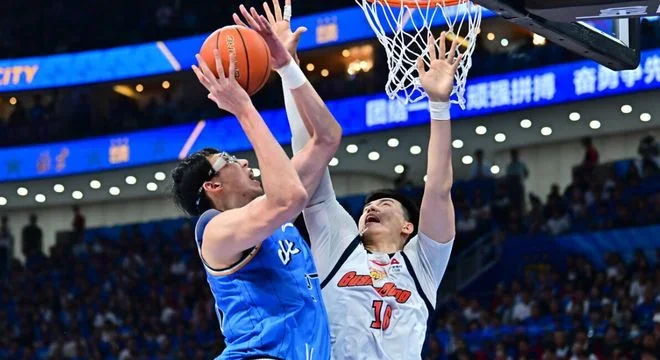
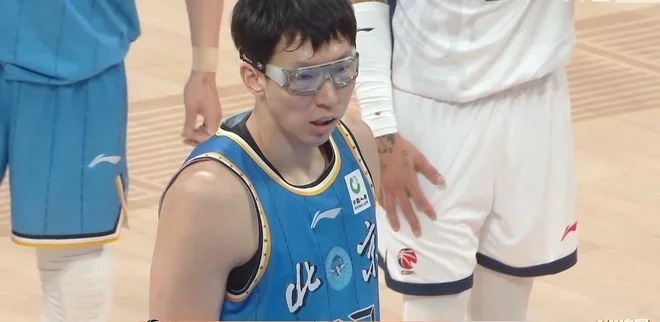
Holding a 10-point lead at halftime, Guangdong collapsed in the second quarter as Beijing launched an 18-0 run to complete a comeback. In the second half, Guangdong’s three-point shooting went ice cold, finishing with a dismal 8-for-31 from beyond the arc. Zhang Haojia and Du Runwang were repeatedly outplayed by Zhai Xiaochuan and Zeng Fanbo, Xu Jie struggled badly, and Hu Mingxuan and Quinn were left to fight alone. Guangdong eventually fell 73-88 to Beijing, exiting the playoffs in disappointment.
At the start of the season, Zhu Fangyu declared the team’s goal was to contend for the championship, but once again, Guangdong was stopped in the quarterfinals. Last season, they were swept 3-0 by Shanxi in the same stage. Now, eliminated 2-1 by Beijing, it marks the second straight year Guangdong has failed to reach the CBA semifinals. With the season over early, the big question is: how will Guangdong adjust during the offseason?
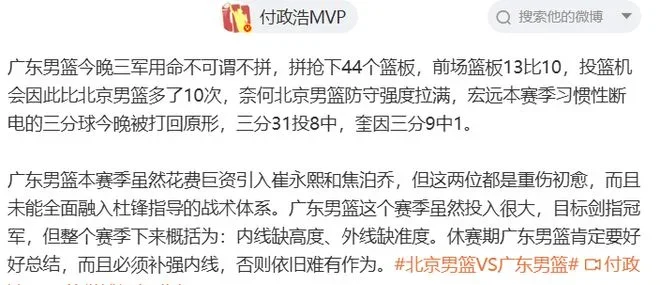
Beijing-based media figure Fu Zhenghao offered his analysis after the loss, pointing to two main reasons for Guangdong’s defeat. First, for two consecutive seasons, the team’s fatal weakness has been its interior defense, which was ruthlessly exploited. This time, Zhou Qi dominated the paint, leading to a staggering disparity in free throws—21 for Guangdong versus 41 for Beijing.
Second, Guangdong fought hard, grabbing 44 rebounds and 13 offensive boards to Beijing’s 10, which gave them 10 more shot attempts. However, Beijing’s defensive intensity was relentless, and Guangdong’s habitual three-point shooting struggles resurfaced. They hit just 8 of 31 three-point attempts, with Quinn going 1-for-9 from deep.
Fu Zhenghao concluded that Guangdong must thoroughly review their performance and prioritize strengthening the frontcourt; otherwise, they will continue to struggle.
These observations are spot-on: a lack of height in the paint and a lack of accuracy from outside have been the root causes of Guangdong’s failed title pursuit. Addressing these two issues would theoretically revive their championship hopes, but the reality is far more complicated. Two harsh truths now confront Guangdong fans.
First, reinforcing the interior is easier said than done. The current CBA environment is challenging, with salary caps and a scarcity of high-quality domestic big men. Guangdong media personality “Biepao Gangbei Zhu” highlighted an awkward reality: in the CBA, you can’t have it all when searching for a center. There is virtually no player over 215cm who can switch on defense, protect the rim, and move quickly across the floor. Last season, among 50 centers tested, only 12 could run the restricted area drill in under 12 seconds. Wang Shaojie, already on Guangdong’s roster, is one of them, but only Zhang Chenzhifeng of Liaoning and Zhou Kefan of Guangsha exceed 212cm—and neither matches the required competitive level.
Second, Du Feng is likely to remain as head coach next season. Quality domestic coaches are scarce, and Du, despite his flaws, is still considered top-tier. He also has deep connections within Guangdong and the provincial sports bureau, making a coaching change unlikely unless he chooses to leave. With Du staying, his tactical system will remain unchanged. The ideal interior reinforcement would be Shen Zijie, who impressed during last year’s National Games while playing for Guangdong. There have been rumors of a potential trade involving Jiao Boqiao for Shen Zijie, which could address the team’s interior weakness. However, Shen may not be available, and Beijing Enterprises may not want Jiao. Furthermore, Wang Shaojie, Guangdong’s best domestic center, is on a two-year loan that is now expiring, and Beijing Enterprises, also lacking big men, may be reluctant to trade.
After the game, the emotional toll was visible. Wang Shaojie broke down in tears, appearing to sense that he may not return to Guangdong next season—buying him out could cost at least 20 million RMB.
With the CBA set to reduce the foreign player registration limit from four to three per team next season, and the total number of registrations dropping from eight to six, with only two mid-season substitutions allowed, the margin for error will shrink even further. If Guangdong still aims to contend, they must be extremely cautious in choosing their new foreign reinforcements this offseason.
